

The Best Strategy to Get Bigger and Faster for Special Operations
It’s no secret that bigger and leaner candidates perform better. And this is true as far as we know about every selection course in the military – from BUD/S to SFAS.
But with so much conflicting information on how to achieve peak selection fitness, I’ve decided to give a deep dive into exactly how you can build muscle and strength while simultaneously getting leaner and running faster.
Read This First
But before I get into the content, I want you to let your guard down. These topics, like getting stronger and faster and building muscle and losing fat clash with preconceived notions of what the human body is capable of.
The primitive, lazy side of your brain will fight to keep you in your paradigm where that’s not possible. Because to venture outside of it would be an indictment of your current mindset – and require you to do more.
So, I want you to open yourself up to these new ideas, because I will outline a roadmap on how you can become the guy everyone looks at, and says “Wow, I’ll be shocked if he doesn’t make it”.

Size, Strength, and Speed Don’t Matter?
But, of course, the common objection to this, is the story of the Olympic swimmer or D1 wrestler who everybody thought was a shoo in but drops as soon as trainings gets tough.
Objectively, the data shows these stories are the exception, not a familiar pattern. So don’t use that as an excuse for your mediocrity. Remember, you get no bonus points for being less fit. In fact, here’s a direct quote from the Naval Special Warfare Director:
“BUD/S continues to become more competitive as candidates are more athletic than ever before – bigger, faster, and stronger. Something to remember when preparing to enter the training pipeline.”
But if candidates are becoming more competitive in every way, why is this story so often recounted?
Well, based on selection’s 70%+ attrition rates, many people will fail – including some (although less) who are exceptionally fit.
Why Body Composition Matters
But since most of you are not the Olympic swimmer or wrestler who needs just a few months to train up. Let’s talk about your first step, and then we’ll talk about building muscle and losing fat.
Your first action is to achieve a body fat percentage that allows you to perform your best – a good place to start is 15%.
There’s a simple and critical reason for this. Imagine a high school offensive lineman who wants to earn a D1 scholarship. If someone told him to just focus on o-line drills, we’d all understand that’s crazy.
Because while drills are great, they’re not going to help if you don’t have the size to play at the next level. There’s a reason why the average tackle in the NFL stands 6’5, 300+ lbs.
Now, selection isn’t as dependent on body composition as playing left tackle.

How Big Should You Be for Special Forces
But data shows a build that correlates with selection success and a build that will virtually guarantee you are NOT selected. I want you to acknowledge this fact so that you can use it to your advantage.
At BUD/S, the most successful candidates are <13% body fat; at SFAS, it’s typically <15%. There is variation in these numbers – but what I can assure you of is that there are no offensive lineman physiques making it through.
What this points to is that body composition matters, and you can tweak it in the same way you do your training to optimize your chances of success.
How To Diet and Train for Special Forces
Now, this brings up a major question of prioritization though – how do you get to your desired body composition as fast as possible – while also improving your metrics like running and strength?
I hate to add more complexity, but to answer it, we need to address two questions:
- Can you build muscle and lose fat simultaneously?
- Can you get faster and stronger simultaneously?
Let’s address the second one first.

Get Faster and Stronger at the Same Time
Unequivocally, yes, 98% of you reading can improve speed and strength simultaneously. The very rare exception to this is if you are already exceptional in running or strength.
| Strength | Endurance |
| 2 x Body Weight Squat for Reps | Run <5:30 minute miles |
If you’re running sub 5:30-minute miles on the endurance side or comfortably squatting more than 2 times your body weight for reps on the strength side, then I would say your scores are exceptional.
If you’re not in that category, and you’re able to get appropriate sleep and recovery, building strength and endurance at the same time is very possible.
Nutrition for Special Forces Training
Building muscle and losing fat is more complex.
While strength and speed can be built quickly through skill acquisition (meaning just lifting and running more), there is no skill acquisition component to muscle gain and fat loss.
They’re simple biological processes:
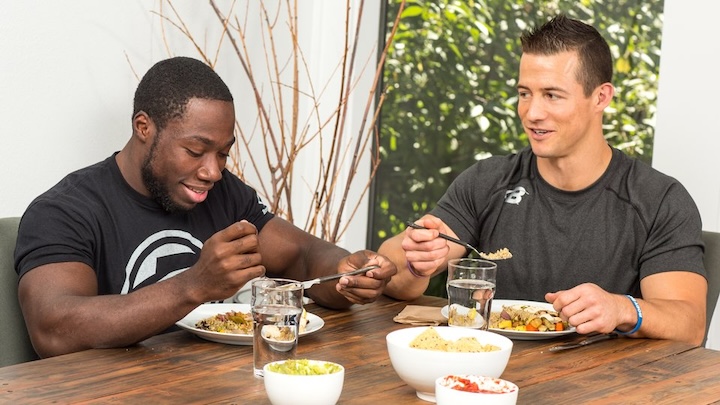
How To Lose Fat
Losing fat requires a caloric deficit – meaning eating fewer calories than you burn. A typical fat loss diet will have you losing 1lb of fat per week – and you can achieve that by eating 500 fewer calories per day – which for most of you is the equivalent of reducing your portion sizes by 15%.
How To Build Muscle
Building mass, on the other hand, is optimized when you are consuming more calories than you burn – a caloric surplus. A typical lean bulking diet would aim to add a few pounds per month which most would achieve by increasing portion sizes 10-15%
While fat loss is a simple math equation of eating fewer calories than you burn, muscle gain has more nuance because when you add mass, some of it will be muscle and some of it will be fat.
Most men can build 30 – 40lbs of muscle naturally over their life time. But the rate of progress is not linear. It’s much faster at the start – as high as 1 – 2lbs per month for some, and then over time the rate of muscle you build slows down.
Building Muscle and Losing Fat
Before we talk about whether you should bulk or cut, there is a third option – which is eating at maintenance – the same number of calories as you burn.
When you do this alongside having an ample amount of protein, ideally 0.8 grams per pound of bodyweight alongside training hard and recovering well, it is possible to build muscle and if your calories are just very slightly under maintenance, you could also lose fat simultaneously.
Seems like the approach should you take right?
The Drawback of Maintenance Calories
Well, there is a drawback. Eating at or just below maintenance calories comes at the cost of being less efficient than a traditional bulk or cut. For example, while in a month, you could lose 4lbs while cutting or, in that same time on a bulk, gain 1 – 2lbs of muscle
While eating at maintenance, you might lose 1lb of fat and gain 4oz of muscle. Looking at yourself in the mirror, those changes probably won’t register, which may feel like you’re not making progress, especially since the scale won’t be moving much at all.

The Best Diet for Special Forces training
So, what should you do.
Since the rate of progress eating at maintenance will be slow,
This is why I recommend you start with a cut to achieve around 15% body fat. This gives you an immediate goal to achieve.
And for many of you, it may require 8 to 12 weeks of dieting to shed the 10lbs of fat you need to lose. I want you to use this diet as test of discipline – but unlike everyone else who is dieting – you also need to focus on your performance, so make sure your training hard, eating lots of protein, and recovering well
Many of you will find an excuse to skip this step and focus on building muscle. But the hard truth is, if you can’t stomach restricting your calories by 15% for a month or two to maximize your chance of success, maybe you’re not as gritty as you think
Recomp or Bulk
Once you’ve shed your dead weight, you’ll now be lighter on your feet and have a true understanding of your fitness since you’ll be at roughly the same body fat percentage you’ll be at for selection.
The benefit of this approach is you can now have an honest evaluation of your strengths and weaknesses. I actually have a full video on how BIG you should be for selection which guides you step by step through your next steps from here.
But, I’ll give you an abbreviated version.
Less than Three Months from Selection
If you’re less than 3 months from selection, you should not bother with bulking – unless you’re severely underweight. Eat at maintenance calories and train hard
More than 3 Months
But if you’re more than 3 months from selection, it’s worth considering your fat free mass index – which is a measure of how muscular you are.
| FFMI Range | Description |
|---|---|
| Below 18 | Below Average |
| 18 – 19.9 | Average |
| 20 – 21.9 | Above Average |
| 22 – 23.9 | Excellent |
| 24 – 25.9 | Impressive |
| 26 – 27.9 | Amazing |
| Above 28 | Head-turning |
I like my candidates to be 21 or higher.
So, if you’re significantly below 21 and you have 6 or more months to go until selection, consider eating in a slight caloric surplus to add some muscle to your frame
For those of you who are close to the 21 range, eat at maintenance calories where you can focus on slowly building muscle and strength without adding extra fat, which will negatively impact your endurance training.
A Warning about Bulking
Before we talk about how you should organize your training. I want to give you all a warning about bulking.
While it’s fun to talk about “eating big to get big” and putting on loads of muscle mass, you need to remember the strength training we’re doing is not strength for the sake of strength – it’s to get strong to perform at selection.
So, while I prioritize weight lifting, I rarely, if ever, recommend someone go on a bulk. Most of you can put on the muscle you need at maintenance or just above maintenance calories which will minimize fat gain and have minimal impact on your endurance training

Body Composition Action Plan
To make this information actionable, here’s your 3-step body composition plan
- Achieve around 15% body fat
- Eat at maintenance, or just slightly above maintenance calories to allow you to build muscle, strength, and endurance simultaneously
- Throughout this process, stay consistent and realistic
- Remember, your plan is only as good as it’s sustainable and you are consistent
4 tips to adjust your training
When it comes to training during this time, here are 4 Tips to Ensure Your Making Progress, whether you’re bulking, cutting, or maintaining

1) Train with Complete Focus
First, train with complete focus. Training is not just a box you check, like cleaning your room or gassing up your car. It requires EFFORT and FOCUS in every session to make progress.
This is why you can have two people who do the same training routine for six months and one makes no progress and the other completely transforms themselves. Next time you work out, make a conscious effort to do more than you did last time.
2) Push Through Poor Training Days
Second, be 100% compliant with your routine and train even when you don’t want to. Not every session will be enjoyable or feel good. And if you only give full effort or train when you want to, then you’re setting the wrong expectation with your training.
It needs to be non-negotiable, so stop making excuses for why you can’t do it and make it happen.
The only caveat to this, is when you’re feeling true pain or injury, or perhaps need a deload. But that’s the exception to this rule.
3) The power of momentum – You need to be training consistently
This brings me to the power of momentum. Once you start training consistently with complete focus and effort, you will get results. There’s no way around it.
And as you get results, this becomes a positive feedback loop-you train hard, you hit personal bests, you feel good, and decide to train hard again.
This is why the fit get fitter.

4) No one is coming to save you
But, there is going to come a point where, despite training hard and giving your best effort, you start to plateau. At that moment, you may call into question your training, your routine, or, if you plateau for long enough, the purpose of training altogether.
At this point, you need to recognize no one is going to save you – not now, or in selection. So either push through the plateau and keep going, or make the decision to quit. Just recognize whatever you decide is your choice, the weights, timed runs and rucks, and training is the same for everyone.
No one is out to get you. And plenty have done what you want to achieve, so you CAN do it. You just need to push through.
Training Routine and Sample Diet
Now let’s walk through a sample training and diet for someone who is looking to build muscle and strength, while simultaneously losing fat and getting faster.
Start by eating to maintain your weight with several servings of protein throughout the day. Track your bodyweight overtime to ensure you’re meeting your goals
If you want to count your calories, you can do that, but I’d say it’s overkill since we’re training for performance and not a bodybuilding competition. But if you’d like to, you can multiply your bodyweight times 15.5 and eat that many calories per day as a starting point, and then multiply your bodyweight times 0.8 and eat that many grams of protein per day.
For training, we’ll do two full-body strength sessions per week on Monday and Thursday along with a calisthenics and metabolic conditioning session on Tuesday. We’ll then do focused run or ruck training on Monday, Wednesday, and Saturday, with optional additional cardio on Tuesday and Friday, depending on your training history and where you are on your journey to getting selected.
If you’d like the full beginner, and intermediate/advanced routine, they’ll be in the description.
| Monday | Tuesday | Wednesday | Thursday | Friday | Saturday | Sunday |
| Full Body (Strength) | Calisthenics + Metcon | Tempo Run | Full Body (Strength) | Swim | Water Confidence | Rest |
| Intervals | Swim | Zone 3 Run | Long Run |
Get the full training routine here.
Conclusion
And if you’re interested in learning just how BIG you should be for selection, check out this article.
