
The Best Weightlifting Program for Special Forces Selection

Stronger, more muscular candidates consistently have higher selection rates.
But most guys hear that and chase the wrong numbers.
They obsess over a 1,200lb powerlifting total… or 100 push-ups… or building big muscles that look impressive on social media but don’t move the needle when you’re smoked, under a heavy ruck, and haven’t slept.
This article is the exact opposite of that.
I’m going to break down how to build strength that carries over to selection, including the standards that matter, the exercises that matter, and how to program it across the phases of prep so you peak at the right time instead of just getting “strong in the gym.”
Why Strength Matters at Selection
You strength train because it gives you reserves.
The same reason we target a 35-minute 5-mile when the standard is 40 is because it makes everything easier and improves your odds when things start stacking up.
Strength works the same way:
Every additional unit of strength lowers the relative effort of the task.
That matters because selection isn’t one event. It’s weeks of cumulative fatigue.
Think about rucking:
If your back and legs are stronger, the 80lb ruck sits easier on your frame. Every step costs a little less. Every minute under load drains a little less. Over dozens of miles, that margin adds up fast.
Small differences in core, legs, and back musculature can absolutely be the difference between finishing and failing.
The Data Is Clear: Strength and Lean Mass Predict Outcomes
Here’s what the research and pipeline data keep showing:
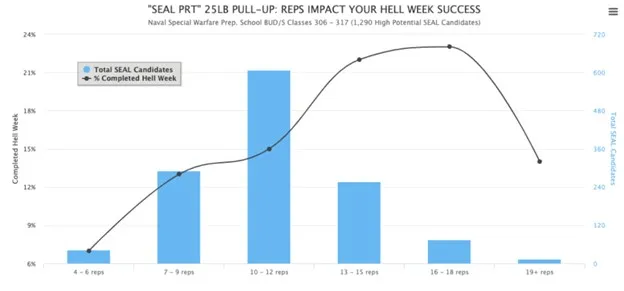
Weighted Pull-Ups Matter (A Lot)
In one BUD/S dataset, candidates doing 4–6 reps of 25lb weighted pull-ups had around an 8% selection rate.
Those doing 16–18 reps had about triple the odds—roughly 24%.
Lean Mass Matters Even More
In an Army SFAS dataset, candidates with the lowest lean mass had about a 20% selection rate.
Those with the highest lean mass were around 58%.
That’s a massive difference, and it’s exactly what you’d expect once you consider log PT, team events, long carries, casualty drags, and the simple reality that heavier work is easier when you have the frame to support it.
| Lean Mass (lbs) | Selection Rate |
| 119.3 ± 13.0 | 20.0% |
| 136.5 ± 3.3 | 27.6% |
| 145.7 ± 3.1 | 31.0% |
| 161.4 ± 8.4 | 58.6% |
“Average” Is Stronger Than You Think
In a 2020 Air Force A&S profile study, the average candidate trap bar deadlifted around 343 lb for 3 reps.
| Event | Mean Score | Standard Deviation (SD) | Passing Standard |
|---|---|---|---|
| 3-mile ruck (60 lbs) | 38:47 min | 4:00 min | 50:00 min |
| 3-rep deadlift | 343.7 lbs | 38.5 lbs | 225.5lbs min |
| Standing long jump | 98 in. | 7.6 in. | 75 in. min |
| Pro-agility test (left/right) | 4.9 sec | 0.2 sec | 5.75 sec |
| Pull-ups | 14.8 reps | 3.5 | 8 min |
| 100-yard farmer’s carry (53 lb kettlebells) | 20.1 sec | 2.1 sec | 31 sec |
| 300m shuttle run | 67.3 sec | 3.1 sec | 82.5 sec |
| 1,500m swim (with fins) | 31:36 min | 3:07 min | 43:50 min |
Candidate Fitness Test (CFT) – Combat-Oriented Testing
Can You Be “Too Strong”?
You’ll sometimes see data suggesting the very strongest candidates—like guys deadlifting 2x bodyweight or doing 25+ bench reps—were less likely to graduate Hell Week.
That doesn’t mean strength is bad.
It means those guys often had trade-offs: too much mass, poor endurance, poor durability, bad recovery, bad movement, or they trained like powerlifters while ignoring the actual demands of selection.
Here’s the simple thought experiment:
If a 170lb guy runs a 12-minute 2-mile, hits 20 pull-ups, and deadlifts 275… and you raise his deadlift to 340lbs without changing anything else, is he less prepared?
Obviously not.
When all else is equal, stronger is better.
The goal is strength that supports endurance, durability, and work capacity.

Strength Standards I Like to See Before You Get “Selection-Specific”
These aren’t world-record numbers. They’re “you’re now strong enough to advance to selection training” numbers.
If you can hit these, strength stops being the limiter and you can shift more energy into endurance and selection-specific work:
- Strict standing overhead press: 155 lb
- Back squat: 275 lb
- Front squat or Zercher: bodyweight x 8 reps
- One-arm DB row: 80s x 10 reps (strict)
- Deadlift: 335 lb
- Weighted pull-ups (+10 lb): 10 strict reps
Are there stronger guys? Absolutely.
But for most candidates, the ROI drops hard once you’re past this range because your bottleneck becomes endurance, durability, and your ability to express strength under fatigue.
Movement Patterns That Must Be Trained
Exercise selection can change over time.
Movement patterns should not.
If your plan is missing any of these, you have a gap in your preparation:
Core patterns
- Hip hinge: deadlift, RDL, snatch-grip deadlift
- Squat: back squat, front squat, Zercher
- Vertical press: standing barbell or dumbbell OHP
- Vertical pull: pull-ups, chin-ups, lat pulldown
- Horizontal pull: barbell row, DB row, chest-supported row
- Horizontal press: bench, DB bench, weighted push-up
- Carry: farmer carry (trap bar or DB), suitcase carry
If You “Can’t Squat or Deadlift”… Read This Twice
If you’re truly injured and can’t train a movement pattern:
You need to rehab and get back to 100%.
Stop pretending you’re preparing for selection and pursue a different path.
Because if your body is so broken you can’t hinge or squat, what makes you think you’re resilient enough to tolerate selection volume?
The good news: almost every injury can be improved—often fully—if you stop making excuses and do the rehab work. Most guys who swear a movement is “impossible” end up doing it again with lighter variations, better mechanics, or with the help of prehab work.
The Program: How to Train Strength Across the Phases of Prep
This is how I structure strength for selection:
Phase 1 (6+ months out): Build strength + Muscle Mass
You lift 3–4 days/week.
You push big compounds hard.
You add targeted hypertrophy in the areas most critical for selection: legs, back, shoulders, trunk.
| Monday | Tuesday | Wednesday | Thursday | Friday | Saturday | Sunday |
| Squat 3 x 5 – 8 Romanian Deadlift 3 x 10 – 12 Chin Up 3 x max reps DB Walking Lunge 2 x 8 – 12 DB Farmer Carry 3 x 100ft Plank 3 x max time | Bench Press 3 x 5 – 8 Pendlay Row 3 x 8 – 12 Weighted Dip 2 x 10 – 12 DB Row 2 x 10 – 15 Biceps 2 x 10 – 15 Triceps 2 x 10 – 15 | Deadlift 3 x 3 – 5 Squat 3 x 8 – 12 Weighted Pull Up 2 x 8 – 10 DB Goblet Squat 2 x 10 – 15 Hamstring Curl 2 x 10 – 15 Hanging Leg Raise 3 x 10 – 15 | Standing OHP 3 x 5 – 8 Seated Row 3 x 8 – 12 Push Up 3 x max reps Lateral Raise 3 x 25 DB Reverse Fly 3 x 25 |
Phase 2 (4–6 months out): Hybrid Training
You drop to 3 days/week strength to make room for more endurance and metcon work.
You continue to bias selection-specific tissue: grip, upper back, static holds.
| Monday | Tuesday | Wednesday | Thursday | Friday | Saturday | Sunday |
| Squat/Front Squat 3 x 5 – 8 Snatch Grip Romanian Deadlift 3 x 10 – 12 Chin Up 3 x max reps DB Farmer Carry 3 x 100ft Plank 3 x max time | Bench Press 3 x 5 – 8 Pendlay Row 3 x 8 – 12 Weighted Dip 2 x 10 – 12 DB Row 2 x 10 – 15 Biceps 2 x 10 – 15 Triceps 2 x 10 – 15 | Deadlift 2 x 3 – 5 OHP 2 x 5 – 8 Weighted Pull Up 2 x 8 – 10 Weighted Push Up 2 x 10 – 15 DB Walking Lunge 2 x 8 – 12 Hanging Leg Raise 3 x 10 – 15 |
Phase 3 (<12 weeks out): Strength maintenance + Transition to Selection-Specific Training
You lift 2 days/week.
Strength is at maintenance.
The focus is converting strength into work capacity: rucks, threshold runs, circuits, heavy cardio, team-event readiness.
| Monday | Tuesday | Wednesday | Thursday | Friday | Saturday | Sunday |
| Squat 3 x 5 – 8 Romanian Deadlift 3 x 10 – 12 Chin Up 3 x max reps DB Farmer Carry 3 x 100ft Plank 3 x max time | Deadlift 2 x 3 – 5 Front Squat 2 x 8 – 12 Weighted Pull Up 2 x 8 – 10 DB Walking Lunge 2 x 8 – 12 Hanging Leg Raise 3 x 10 – 15 |
Weekly Split Options
Option A: 4 days/week — Lower/Upper (with back work on lower days)
This is my favorite because it keeps volume balanced and lets you accumulate more back work without turning upper days into marathons.
- Lower + Back + Grip
- Upper
- Lower + Back
- Upper
Option B: 4 days/week — Push/Pull (legs split across days)
Not bodybuilding “push/pull/legs.” This is a full-body variation:
- Push day: press + squat/quad dominant
- Pull day: pull + hinge/ham dominant
Option C: 3 days/week — Lower/Upper/Full Body (with back work on lower days)
This is another favorite of mine.
- Lower + Back + Grip
- Upper
- Full Body
Option D: 3 days/week — Push/Pull (legs split across days)
I’m not a huge fan of this variation, but some athletes prefer to split leg volume across each day
- Push day: press + squat/quad dominant
- Pull day: pull + hinge/ham dominant
- Full Body

Where Most Guys Screw This Up
It’s usually one of these three:
1) Intensity
Most people train too easy.
A working set should feel like a near max effort 400m repeat. You don’t need to hit failure every time, but you should be hitting each set within a rep or two of failure.
2) Volume
If you’re hitting roughly 6–8 hard sets per muscle group per week, you’re in a good spot, as long as your intensity is on point and you’re recovering well.
3) Consistency
With other higher priority sessions like runs or metabolic conditioning it can be easy to push off your lifts. But you want to make sure you’re hitting each muscle group at least once per week. Keeping a consistent training schedule is not only critical for your strength goals but also to build strong habits.
