
Special Forces Selection Body Composition: Ideal Weight, Body Fat %, and Muscle Mass Targets (With Data)

The Harsh Truth: Body Composition Matters at Selection
You’ve probably heard it before:
“It’s not the size of the dog in the fight, it’s the size of the fight in the dog.”
And that’s right.
But there’s a harsher truth no one wants to say out loud: body composition matters at selection. A lot.
When you look at what selection actually is—log PT, ruck marches, long carries, team events—it’s obvious why. Size and strength give you a real edge.
This article breaks down the patterns we keep seeing across special operations pipelines and what you should actually do with that information.
The Good News: You’re Not Being Drafted
Before we dive into the numbers, here’s the good news:
While there is a frame and body composition that shows up more often in successful candidates, cadre don’t evaluate you like a football scout. They’re evaluating performance and character under stress, not how big you with or without a T-shirt.
But we also need to be honest: physical traits will make tasks easier or harder.
At SFAS, the top-performing ruckers had massively higher odds of selection:
- Q4 (slowest): 6%
- Q3: 27%
- Q2: 43%
- Q1 (fastest): 67%
Now, rucking performance isn’t a “trait.” It’s an outcome.
But it’s an outcome heavily influenced by lean mass, limb length, height, and total bodyweight. And that’s where people get uncomfortable, because some of those factors are outside your control.
Because even if you can’t control everything, you can control enough to radically improve your odds. And if you’re serious about getting selected, you don’t get to ignore variables just because they’re inconvenient.
What the Data Says: BUD/S and SFAS Patterns
Across pipelines, the same predictors keep showing up:
- Being leaner helps
- Having more lean mass helps
- Being able to move under load for a long time helps
- Strength relative to bodyweight matters—especially for upper body pulling
Here are two of the clearest examples.
Weighted Pull-Ups and BUD/S Outcomes
At BUD/S, candidates who could do 4–6 reps of 25-lb weighted pull-ups had an 8% selection rate.
Those who could do 16–18 reps had triple the odds with a 24% selection rate.
Lean Mass and SFAS Outcomes
At Army SFAS, the relationship with lean mass is even more blunt:
- Lowest lean mass group: 20% selection rate
- Highest lean mass group: 58.6% selection rate
Lean Mass (lbs) → Selection Rate
- 119.3 ± 13.0 → 20.0%
- 136.5 ± 3.3 → 27.6%
- 145.7 ± 3.1 → 31.0%
- 161.4 ± 8.4 → 58.6%
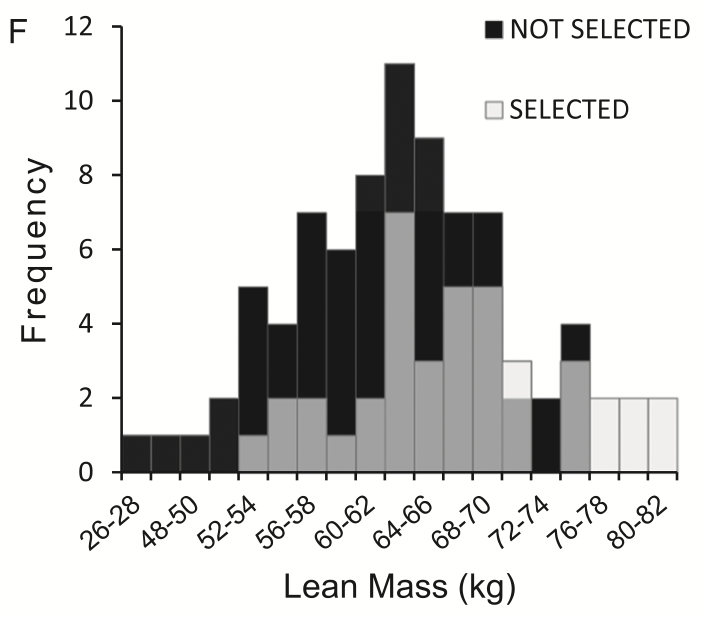
So yes, upper body pulling strength and muscle mass matter. A lot.
And if you’re wondering what “average” strength looks like in real candidates: in a 2020 Air Force A&S profile study, the average candidate trap bar deadlifted 343 lbs for 3 reps. In other words, a considerable amount of strength is required just to be average.

The Ideal Body Fat % Range for Selection Performance
Now let’s talk body fat percentage because this one is low-hanging fruit for most candidates.
At BUD/S, the leanest candidates (under ~15%) were about twice as likely to complete Hell Week compared to those over 20%.
Body Fat % → Hell Week Success Rate
- 8% → 23%
- 11% → 21%
- 14% → 18%
- 17% → 17%
- 20% → 12%
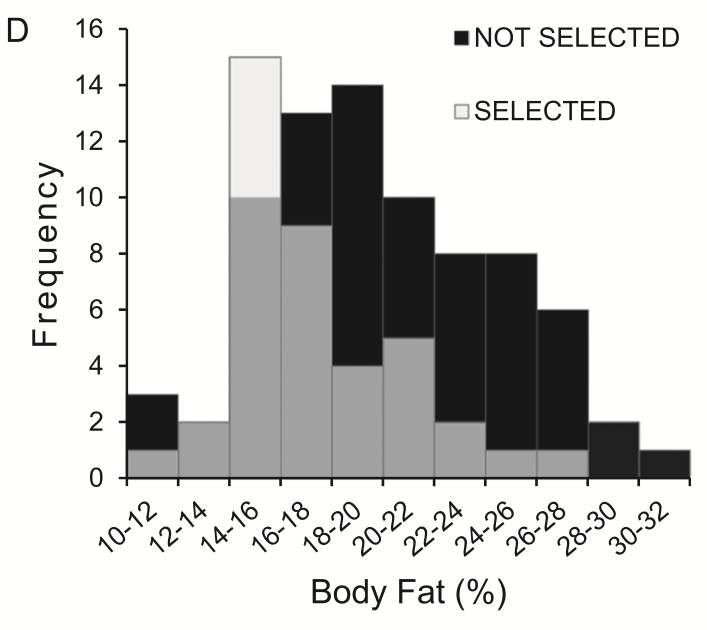
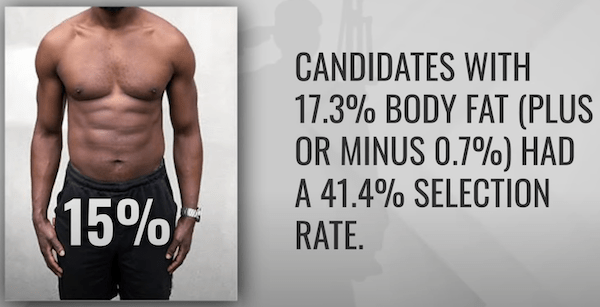
And at SFAS, it’s even more stark:
Body Fat % → Selection Rate
- 14.2% → 51.6%
- 17.3% → 41.4%
- 20.1% → 28.6%
- 25.2% → 13.8%
Why Higher Body Fat Hurts Performance
Body fat doesn’t just affect “odds.” It affects performance on multiple levels:
- It increases the energy cost of all movement
- It adds stress to your joints and connective tissue
- It masks your true fitness, making you slower and less conditioned than you “should” be
This is why lower body fat is associated with better performance across events like:
- APFT
- pull-ups
- run
- ruck march
- obstacle course
- land navigation
Here’s the simplest way to think about it:
If you’re 195 lbs at 22% body fat, that’s about 152 lbs of lean mass and 43 lbs of fat mass.
If you drop to 15% body fat while keeping the same lean mass, you’re about 179 lbs (same lean mass, ~27 lbs fat).
That version of you with less fat mass is almost always faster, more durable, and quicker to recover.

The Practical Target
Don’t take this to an extreme and get stage-lean. That can mess with recovery and durability.
But the practical takeaway is simple:
- If you’re above 20% body fat, you’re leaving performance gains on the table.
- A strong target for most candidates is ~12–15% body fat going into the final phase of prep.
Lean Mass: Why “Strong for Your Size” Isn’t Enough
Another variable that’s largely in your control is lean mass—and candidates with more of it consistently outperform.
Yes, part of that is because lean mass correlates with strength.
But it’s not just that.
Selection doesn’t care about pound-for-pound strength.
I had a conversation like this with an athlete who went on to get selected. He was around 140 lbs and incredibly strong for his size—pound for pound, no question.
But I had to be up front:
“Selection doesn’t care about pound-for-pound strength. A 65-lb ruck is almost half your bodyweight. For a bigger guy, it’s a third. The ruck is the same, but your lighter body has to work way harder to move it—no matter how strong you are.”
He eventually got selected around the 150-lb range, which is still light. But that’s when it clicked: you can be very strong in the gym, and if your body mass is low, the same events hit you harder.
That’s exactly what the SFAS lean mass data reflects.
What Selected Candidates Actually Look Like (Averages Across Pipelines)
Now let’s zoom out and look at the averages across branches:
- Navy SEAL (enlisted): 5’10”, 180 lbs
- Navy SEAL (officer): 5’11”, 180 lbs
- Army SFAS: 5’10”, 183 lbs
- Air Force Special Warfare: 5’10”, 173 lbs
Here’s the takeaway:
These are highly achievable builds.
If the average guy is 5’10”, at 12–15% body fat he might be around 160 lbs without any weight training. Add 10 pounds of muscle and he’s right in the range of the average selected candidate.
This isn’t the NBA. You don’t need to be a freak.
Target Weight by Height (Minimums + Practical Ranges)
This chart is a guide, not a rule.
There are plenty of successful candidates outside these ranges.
But as a coach, I generally don’t like athletes shipping below the minimum. It almost always shows up under a ruck or long carry events.
Recommended targets (based on 5’10” normalized weights of 175, 180, 185):
| Minimum | Normalized for 175 | Normalized for 180 | Normalized for 5’10 185 | |
| 63 | 140 | 142 | 146 | 150 |
| 64 | 144 | 146 | 150 | 155 |
| 65 | 148 | 151 | 155 | 160 |
| 66 | 151 | 156 | 160 | 164 |
| 67 | 154 | 160 | 165 | 169 |
| 68 | 157 | 165 | 170 | 175 |
| 69 | 161 | 170 | 175 | 180 |
| 70 | 165 | 175 | 180 | 185 |
| 71 | 170 | 180 | 185 | 190 |
| 72 | 175 | 185 | 190 | 196 |
| 73 | 179 | 190 | 196 | 201 |
| 74 | 184 | 196 | 201 | 207 |
| 75 | 189 | 201 | 207 | 212 |
Training Adjustments If You’re Undersized or Oversized
If You’re Underweight:, Build Lean Mass Without Losing Endurance
If you’re undersized, your goal is simple: add lean mass while maintaining or improving your conditioning.
That means:
- Lift 3–4 days/week
- Hit 5–10 hard sets per major muscle group
- Prioritize legs, back, shoulders, grip
- Use heavy compound lifts: squats, deadlifts, overhead press, rows, weighted carries
- Still run 2–3x/week
Nutrition is the strongest lever that moves your bodyweight the fastest.
The easiest way to add size without overthinking it is to swap in higher calorie density foods:
- chicken thighs instead of chicken breast
- 80/20 ground beef instead of lean steaks
- whole milk instead of fat-free
- multiple protein servings per day
If You’re Heavier: Is Being Big A Problem?
This one is more nuanced.
Just because you’re heavier than the 5’10” 185 normalized target does not automatically mean you’re at a disadvantage.
In fact, in SFAS data, selection rates were highest in the 190–216 lb range (normalized for 5’10”):
Body Mass → Selection Rate
- 158 lb → 18.2%
- 175 lb → 30.9%
- 190 lb → 36.4%
- 211 lb → 35.9%
So if you’re a big guy and you’re crushing run/ruck times and recovering well—fantastic. You’re in a great spot. The data supports that.
But here’s why that scenario is rare:
It takes years of consistent hard lifting to build that much functional muscle. Most guys who are “big” aren’t big because they’re jacked. They’re big because they’re carrying excess fat, and that usually shows up as slower run and ruck performance.
If that sounds like you, your first move is:
- Get lean not shredded, just around 15% body fat
- Drop lifting to 2 sessions/week (enough to maintain muscle)
- Shift your focus to:
- running 3–4x/week
- rucking weekly or every other week
- add non-impact cardio as needed
On the nutrition side:
- Prioritize low-calorie-density foods high in protein and fiber
- Maintain a small deficit that lets you train hard without feeling wrecked
Remember, we’re training for selection performance, not bodybuilding.
Conclusion
Selected candidates will have many shapes and sizes.
You’ll see:
- 5’8” 160-lb guys flying on runs
- 6’1” 200-lb candidates crushing log PT, carries, and rucks
- plenty of variation in between
But the guys who rarely make it are predictable:
- the ones who max out muscle at the expense of endurance
- or the runners who max out endurance to the detriment of muscle and strength
There’s no perfect body type.
But there is a pattern:
Successful candidates are lean, muscular, strong, and conditioned.
They’re not genetic anomalies. They’ve just maxed out what they can control.
So if you’re overweight, cut the fat.
If you’re light and weak, get bigger and stronger.
If you’re out of shape, commit to a plan, and fix it.
It’s up to you.
